Chapter 0: What is Brainstorm?
This is the start of a second, independent tutorial track in this repository: Brainstorm, a free application for analyzing MEG, EEG, and related brain-imaging data. It sits alongside the MNE-Python track covered elsewhere in this repo, but it is a different kind of tool, and this track can be read on its own — no Python or MNE-Python knowledge required.
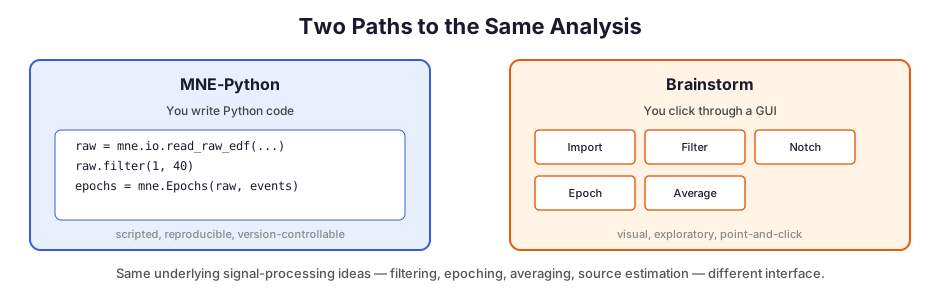
Brainstorm in one paragraph
Brainstorm is a free, open-source application (built on MATLAB, but also available as a standalone program that needs no MATLAB license) for analyzing MEG, EEG, ECoG, and related signals. Instead of writing code, you work through a graphical interface: you click on files in a tree, drag them into a processing tab, choose an operation from a searchable list, and see the result appear as a new file you can visualize immediately in 3D. It was built at USC and McGill and is widely used across neuroscience labs, especially for source localization — reconstructing which parts of the brain produced a given signal, not just what a sensor on the scalp picked up.
Why a GUI, when MNE-Python already does this?
They solve overlapping problems with different trade-offs, and many labs use both:
- Exploration and teaching. Clicking through a recording, trying a filter, and immediately seeing the result is often faster to learn and faster to explore with than writing code first.
- No programming required. A collaborator who has never written a line of Python can still process and visualize their own data.
- Built-in 3D visualization. Cortical surfaces, source maps, and sensor topographies are one click away, with no plotting code to write.
- Reproducibility and scale. This is where MNE-Python tends to win — a script can run identically over 50 subjects and be checked into version control; repeating 50 subjects by hand through a GUI is slower and more error-prone.
Neither replaces the other. Chapter 7 of this track comes back to this question once you've seen both.
What this track covers
Eight chapters, the same zero-prior-knowledge style as the MNE-Python track, but walking through Brainstorm's interface instead of code:
| # | Chapter |
|---|---|
| 0 | What is Brainstorm? |
| 1 | Installation and First Launch |
| 2 | Protocols, Subjects, and Studies |
| 3 | Importing Data |
| 4 | Preprocessing |
| 5 | Sensor-Level Analysis |
| 6 | Source Localization |
| 7 | Bridging Back to MNE-Python |
If you're brand new to EEG/MEG concepts (what a channel is, what an event marker is, what "referencing" means), the EEG Fundamentals chapter of the MNE-Python track covers that background — it's tool-agnostic and applies just as much here.